TRIGGER WARNING: Mentions of Suicide and Trauma
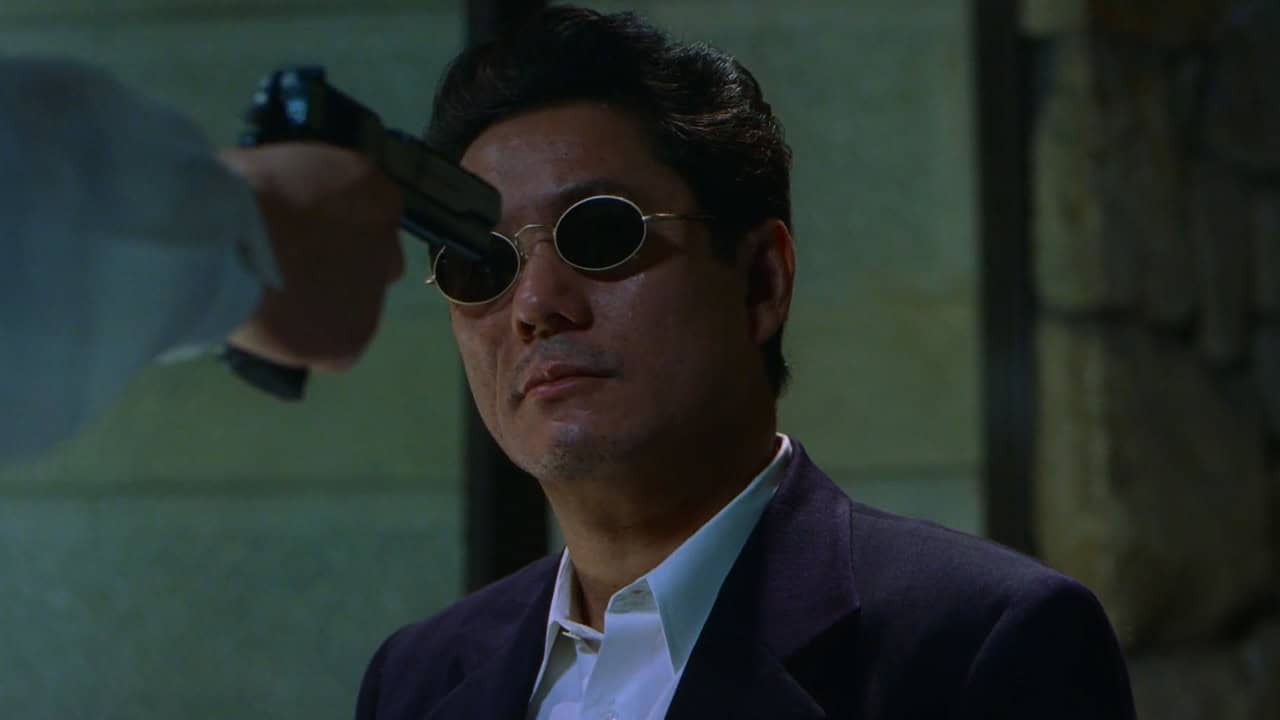
Five or six years ago, I was served up a tweet where somebody had posted a few screenshots of some movie and was gushing about how cool the guy in the screenshots looked. I agreed, so I grabbed one of the images and sent it over to my mom (an optometrist) and, a couple of weeks later, I was the proud owner of some new oval-shaped sunglasses with gold frames. I’ve gone in and out of wearing them since, sometimes feeling that they’re a bit too pretentious or fashion-forward, but recently I’ve been wearing them much more. I never saved that post, though, or even the name of the movie in it.
Fast forward to a few weeks ago: I’ve been off Twitter for years, and though I’ve gone back to try and find that post, I’ve never had any luck. About a month ago, though, I came across a similar post on Instagram. Those same screenshots, those same sunglasses. This time I saved it, and since I’m on a movie kick right now, I watched it about a week later. I expected it to be some action-packed yakuza movie, but I really could not have been more wrong.
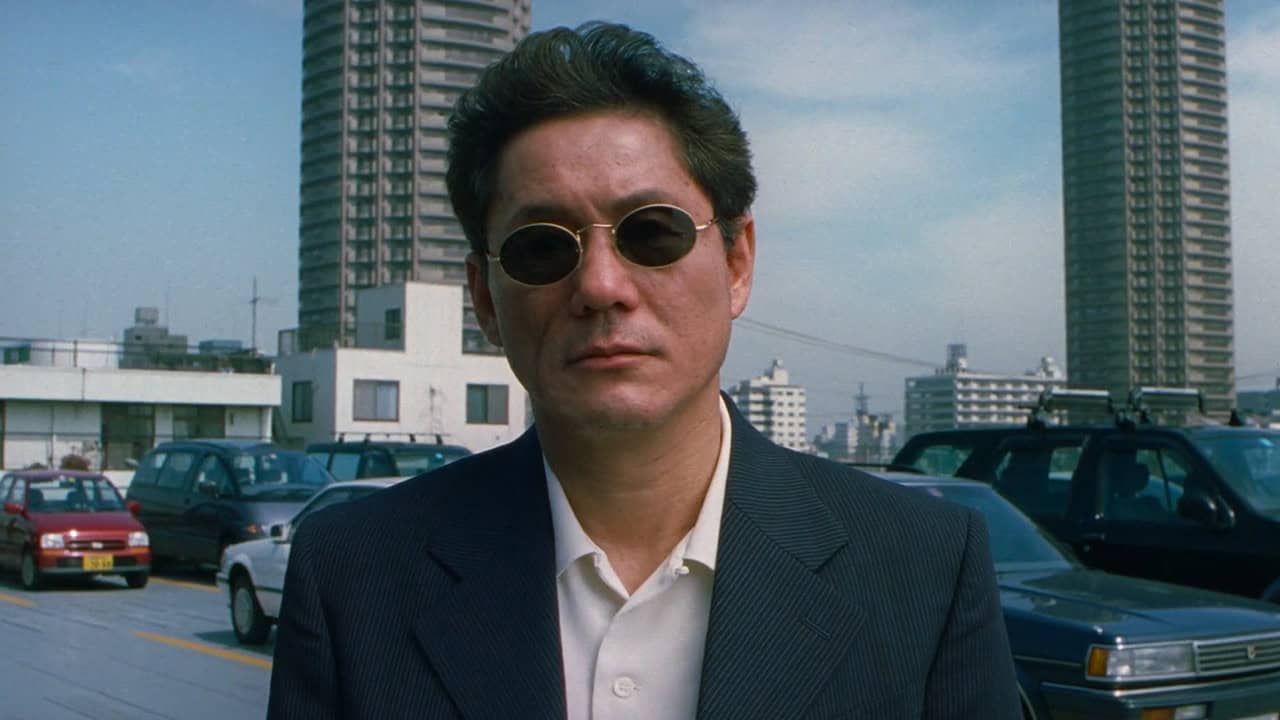
HANA-BI is a loose, abstract character drama, directed by and starring Takeshi Kitano (of Takeshi’s Castle, Takeshi’s Challenge, Merry Christmas Mr. Lawrence, etc.), that is constructed completely through subversion of the action crime genre. It has all the structural components you’d expect, but every time you think you know what’s coming, you’re invariably wrong. The movie’s not just having fun with you either, it’s just trying to break you out of your expectations, to prime you to experience it with eyes unclouded. Spoilers from here on out, by the way.
The movie starts slowly, introducing us to our two main characters: Detective Nishi, played by our director Takeshi Kitano, and Detective Horibe, played by Ren Osugi. They’re longtime friends and are on their way to relieve some younger detectives on a stakeout. Horibe, a family man, tries to convince Nishi to visit his wife at the hospital before heading to the stakeout. Nishi’s a quiet, sullen man, and seems reluctant, but goes anyway. Horibe ends up relieving the other detectives alone. While visiting his wife, Nishi gets word that Horibe’s been shot, and thus begins the tour of misery that is the first third of HANA-BI.
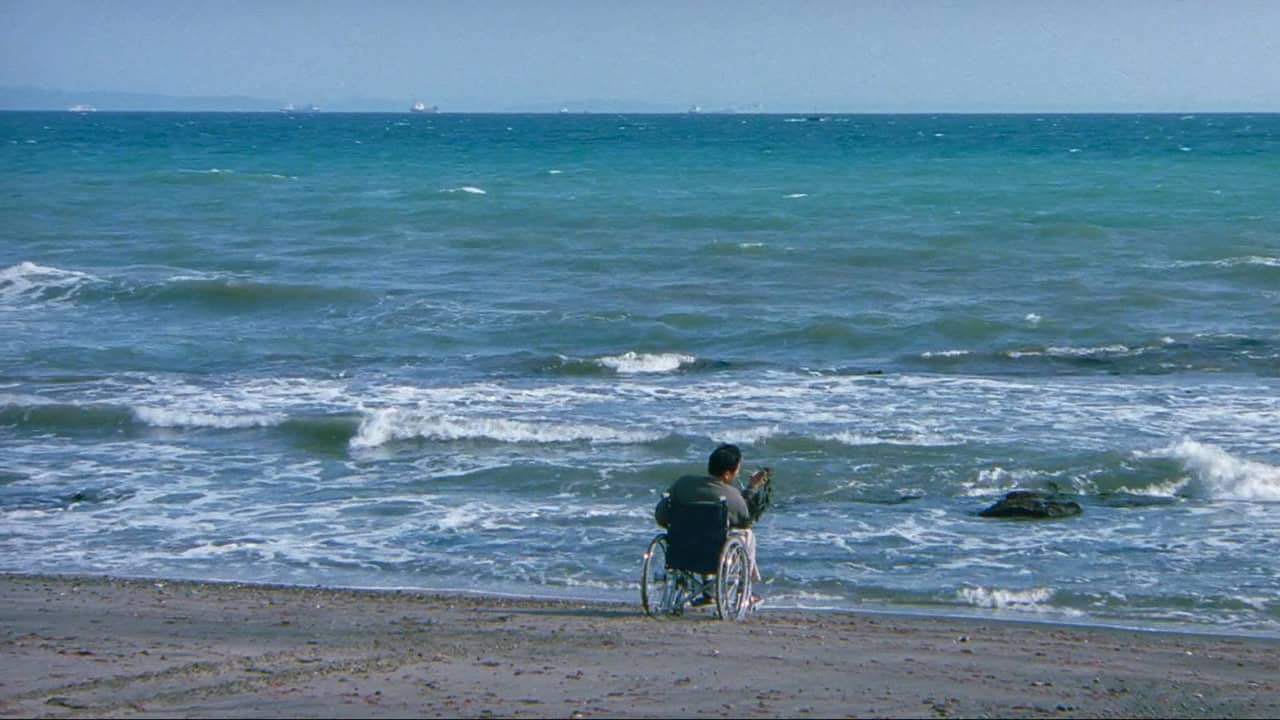
That sounds like a great start to a revenge story, but there’s almost none of that here. Instead, we flash forward a few months. Both detectives are off the force. Horibe’s wheelchair-bound, and his wife and daughter have left him, while Nishi’s been borrowing money from the yakuza to pay for his wife’s treatment, and seems even more depressed than before. He also seems quicker to violence, as we get a quick, yet rather bloody scene of some thugs foolishly accosting him for his debts.
I’m worried that I’m making this all seem very concrete and clear, but rest assured; this is all paced like a tense dream, slow and cold and just a bit out of order. The action’s always just off screen and passes in a blink, while the longer shots and scenes are all focused on landscapes, the sea, or Nishi’s stone-like face. His eyes are nearly always hidden by those sunglasses, but they seem to bring out the true sadness of Kitano’s performance. He wants you to ask what’s going on in there, so he doesn’t show the slightest hint.
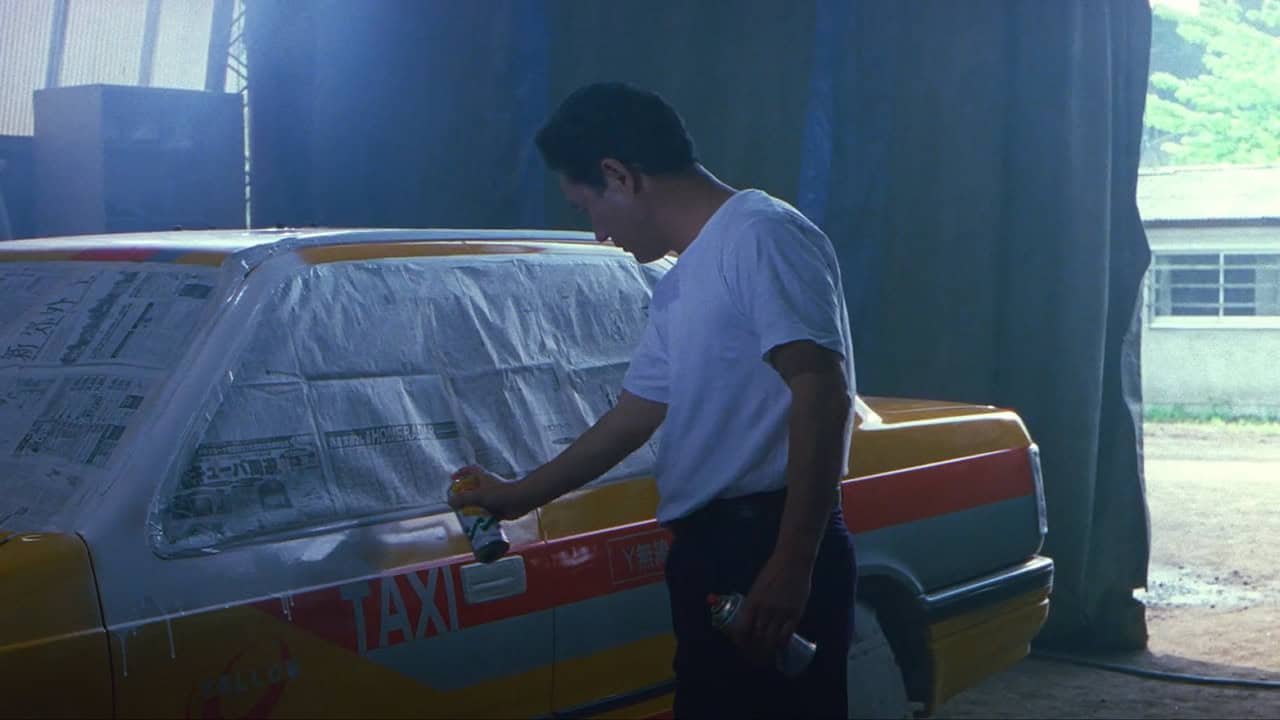
From there, the now isolated Horibe slowly submerges into a deep depression, further and further, until a package from Nishi shows up at his place. It’s full of art supplies (including a beret!), something Horibe had mentioned to Nishi when he visited once. At the same time, Nishi begins planning a way out of his debt. He buys a taxi and some police lights from a junk shop, pulls out an old police uniform, and starts painting the taxi like a cop car. Intercut with that, we get scenes of Horibe being inspired by a flower shop, cut with close-ups of the paintings certain flowers inspired.
Nishi’s bank heist goes off almost too fast to take in. He walks in, shows his gun, the teller gives him a bag of money, and he walks out. No words spoken, no shots fired, not even five minutes go by. The rest of the movie is focused on Nishi taking his wife on a road trip, while eventually both the yakuza and the police figure out he robbed that bank and start lazily chasing him. The road trip is so sweet, so heartwarming, yet not anywhere near overly saccharine. Almost no words are spoken, actually. All the sweetness comes from Kitano’s chops as a slapstick comic, which might sound strange, but I swear it’s the most I’ve ever related to an onscreen relationship, the most I’ve felt a movie’s romance mirror my own. It’s the way real adults flirt and show love.

If you’ve ever been depressed for an extended period of time, Nishi may seem familiar. He’s this depressive fantasy, someone you wish you were, or you had, at your darkest. Someone who can fix everything, someone endlessly competent and well-loved, yet quiet and cool and funny when they want to be. Especially in regard to traditional masculinity, Nishi fills every societal role to a T. He takes care of his wife, and he’s tender around those he cares for, but strong and violent when the time requires. In a way, he’s not dissimilar to Bruce Willis’s John McClane in Die Hard; he’s just spun in the opposite way.
In fact, I’d hazard a guess that Nishi is specifically who Kitano wanted to be at the time. Kitano was in a motorcycle accident in 1994, one he’s referred to as an “unconscious suicide attempt” (Lee Server, Asian Pop Cinema, pg 82), after which his face was partially paralyzed, and he took up painting. Horibe’s paintings, in fact, are the paintings Kitano made in this period. Horibe’s painting doesn’t exactly pull him out of the depression; it doesn’t even keep him out of boredom, but it gives him an outlet.
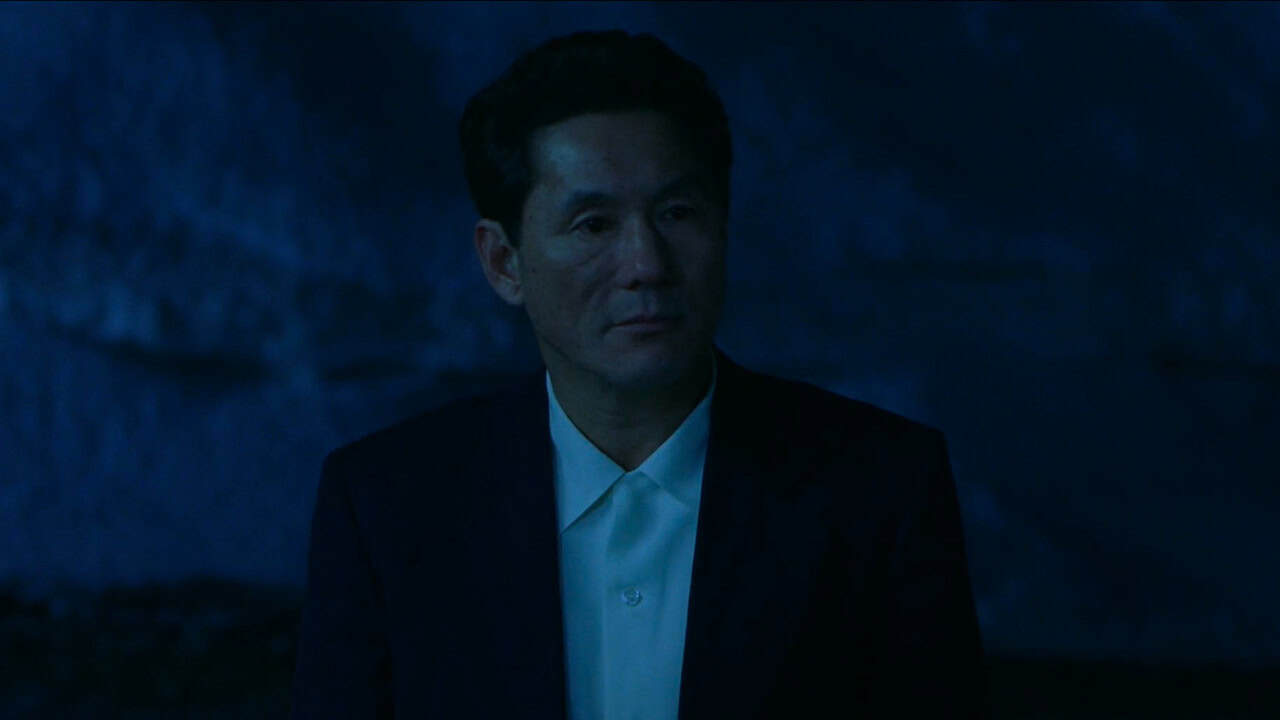
In my mind, this marks Horibe as Kitano’s self-insert, not Nishi as one may assume. Nishi is the idealized self, both for Horibe, who’s stuck at home, painting, unsure of what to do, confined to a wheelchair, and Kitano himself for the same reasons. You could also see Nishi as the professional Kitano given life, the sum total of his hypermasculine gangster movie characters and slapstick game show performances, sentenced to dealing with the trauma and tragedy of real life. And that’s why he must die.
I won’t spoil exactly how it goes down, and honestly it’s kinda purposefully vague, but Nishi dies. Of course he dies. Nishi is not real. I don’t just mean that he’s a character in a movie, but that he’s an avatar for how you wish you could deal with things, the kind of ideal you have to rid yourself of before you can get better. You can’t get over trauma by imagining the superhero you wish you were, you have to accept your lot, and you have to push hard against sitting in your pain. You can learn from your Nishi, take bits here and there, but you can’t be him. You can’t fix all your problems, you have to accept them and live with them. Only then can you push through.
 ObserverCrew Picks
 bserver
 bserver