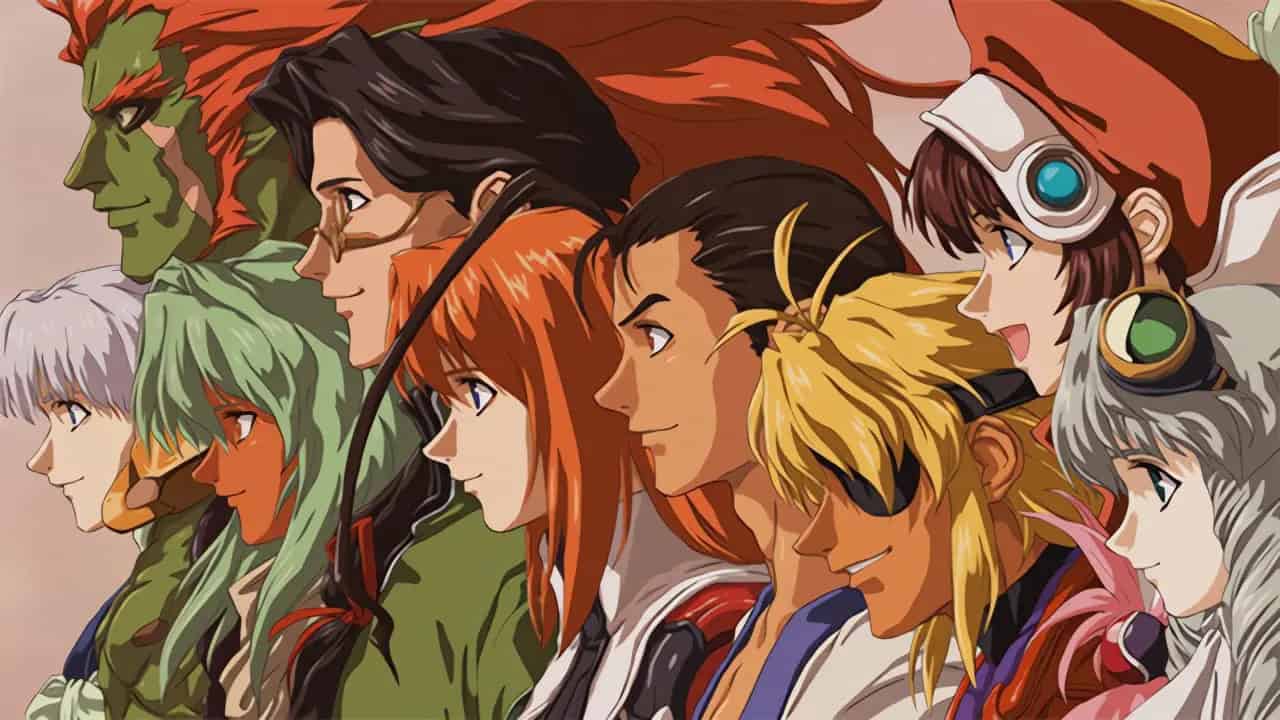
Before Xenoblade Chronicles, there was Xenosaga. That’s not what we’re talking about today. Before Xenosaga, there was Xenogears—a directorial debut for the sometimes controversial, though no doubt beloved, Tetsuya Takahashi. Off the heels of working on field maps and graphics on several genre-defining titles (Final Fantasy IV–VI, Front Mission, Chrono Trigger), Takahashi and his wife Kaori Tanaka pitched their own game; initially the project was envisioned as the seventh installment of the Final Fantasy series, then as a sequel to Chrono Trigger, and, finally, as its own project.
Xenogears is cited as not just one of the crowning achievements of the RPG genre, but of the medium as a whole. That’s the impression I had going in anyway. It’s not mentioned often due to its sparse appearances since release—with Takahashi leaving Square to create Monolith Soft soon after, where he’d develop the other aforementioned series—but when it is, it’s all unanimous praise. So, after 80 hours, two discs, and several months of a slow-burn, I asked myself a question: is Xenogears one of the greatest stories in gaming?
Nah.
Minor spoilers for Xenogears ahead!
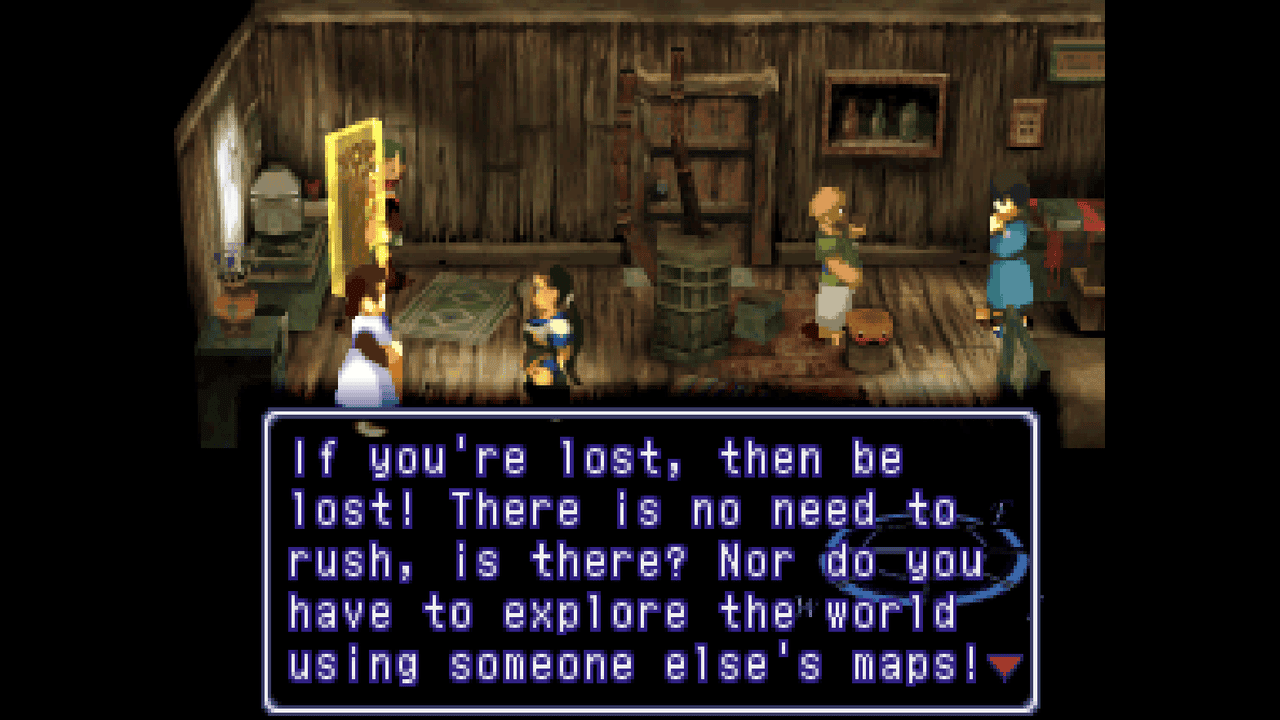
I could point to its troubled development as an easy out for my reasoning: the lack of content on the game’s second disc (you know it’s real retro hours when we’re talking about multiple discs), the rushed ending sections of the first disc, etc. Truthfully, however, the problems lie far deeper, and pop up way earlier than that. Xenogears is a directorial debut through and through—it’s messy, ambitious, and rich, and if you can slow your roll to appreciate what is there, there’s plenty to fall in love with. The creation of this universe is an amazing achievement. But the act of playing through it made me go cuckoo-crazy!
There were times when I could barely make progress before feeling like I had to take a break, whether due to certain annoyances or some insanity that I just could not handle. It’s hard to speak of a “unit” of Xenogears, in spite of it having named chapters—it’s a crazy ride that you just have to hop off sometimes, like stopping a movie in the middle to get back to it the next day. One day of playing will be spent mostly on watching cutscenes with a few encounters, only for the next one to still be watching cutscenes. Another day will be spent grinding out its unique mechanics. Yet another will be actually exploring a new location before returning to the ultimately most prevalent, uneven cutscene-combat combo.
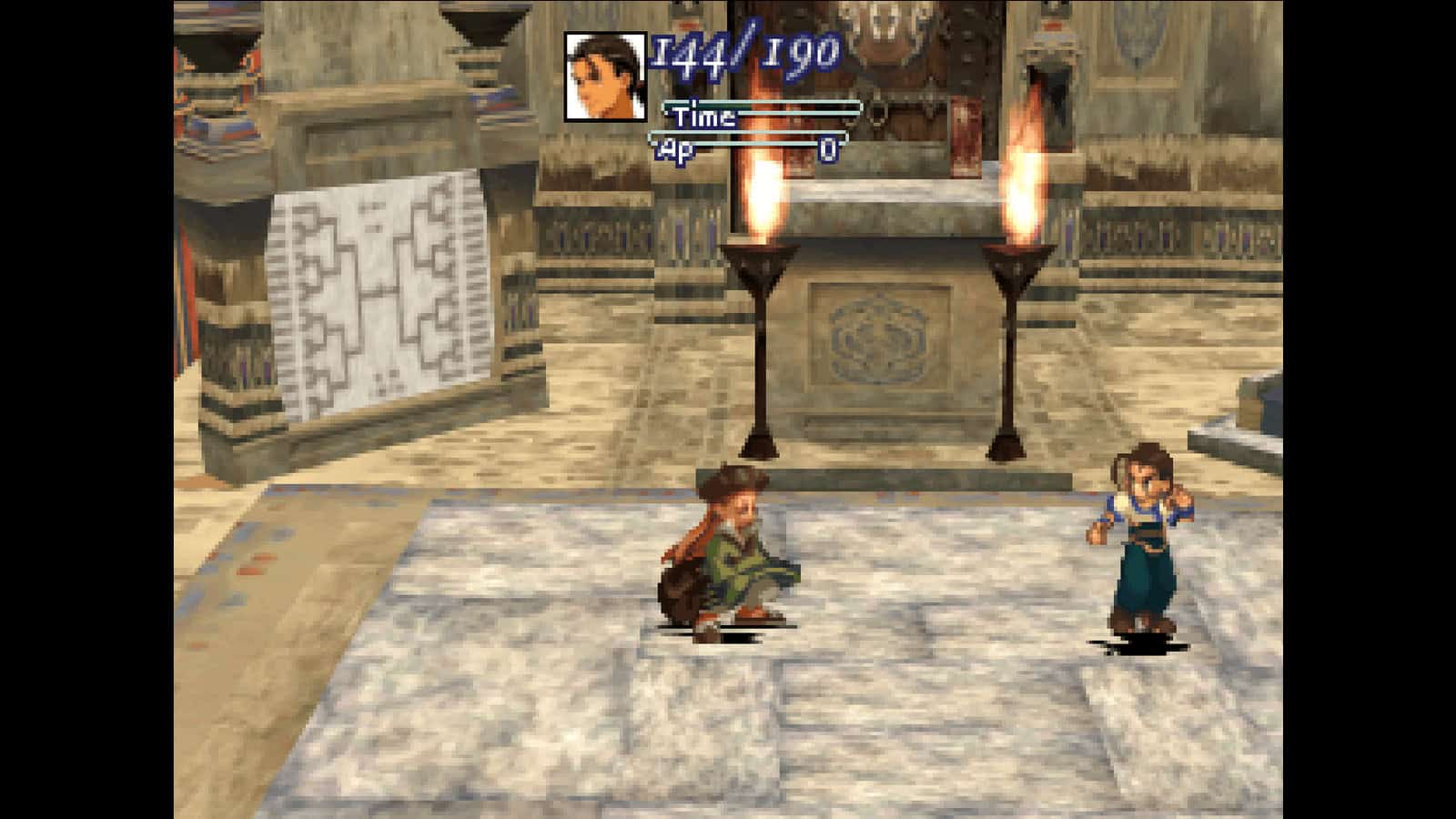
A lot of the early Xenogears (which is about 30 whole hours) is very reminiscent of early Chrono Trigger: rich hubs with a lot of interactivity and secret quests. Think of that game’s opening carnival segment and the subsequent prison escape, and how many optional activities can be found in each. Spaces that feel real, with a sense of purpose even if there’s some friction in traversing them. These were my favorite parts of the game; when Xenogears gives itself time, it can create places that are a joy to explore. In fact, the game begins in one.
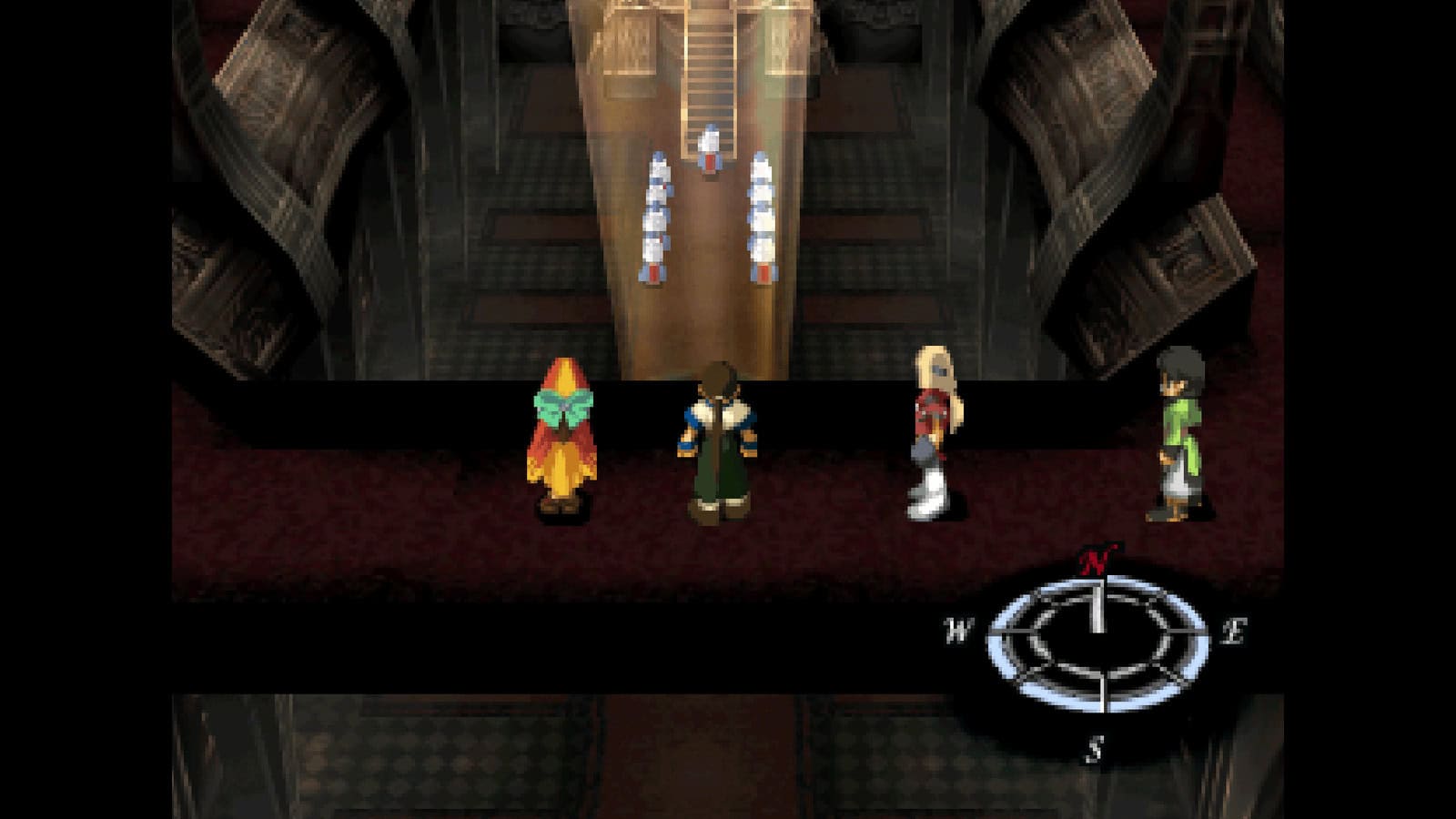
Fei Fong Wong has been living in Lahan Village for three years, without any memory of his past. Everyone, however, for as much as they accept the new member of their community, knows there’s some secret at play, none better than the mysterious doctor Citan Uzuki, living with his wife and child atop the nearby hill. You know he knows more than he lets on because he talks to himself when Fei leaves. The life of the village is soon turned upside down as mechs land and fight on top of it, causing utter destruction, ending with Fei taking up control of one of the machines and subsequently blowing up everyone in sight… including the love of his life, and her husband-to-be on the day before their wedding.
Our protagonist becomes ostracized from his community and leaves to not cause them more trouble. As he escapes to a nearby capital in hopes of finding answers as to why the military was fighting over his home, he finds one of the pilots that took part in said fight in the forest. The person, whose name we later find out is Elly, threatens him, even calls him a lesser being, but ultimately asks for his help to find a way out of the unknown territory. The two are a lot more similar than it initially seems, which the player finds out thanks to a mysterious 2D-animated flashback that the characters themselves don’t seem to be privy to. After a few fights, there’s another cutscene, and another flashback. Huh.
You may notice a sort of pattern. Introductions are often accompanied by what I’ll call a “teaser scene.” These scenes serve as a look into the wider world, showing imagery, ideas, and characters you won’t actually begin to understand until much, much later. Xenogears loves doing this. On one hand, it expands the world, adding a layer of mystery each time a major event takes place. It truly feels like you’re just a pawn in this massive game. On the other hand, it is incredibly frustrating.
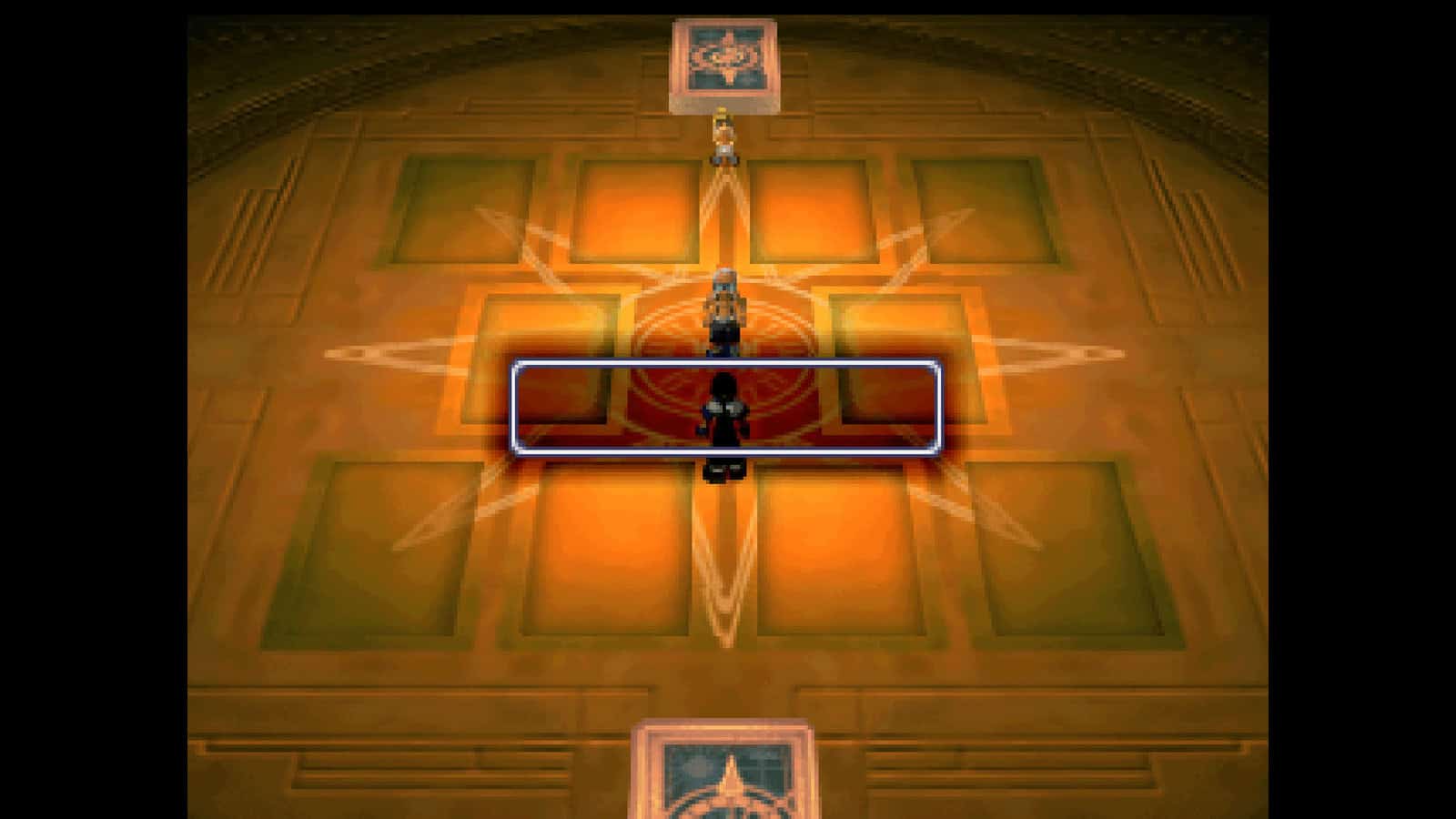
You have to hang around Citan, who’s drip-feeding everyone information at a snail’s pace, dumping walls of information only whenever it’s necessary. Usually, these revelations are followed by some faster-paced segments, with characters rarely having the time to truly take in and ponder the implications of these major reveals. Obviously this leads to the player mistrusting Citan, but there are moments where his teasing reaches comical levels. It feels as if he’s simply addicted to teasing, and cannot get himself to reveal anything unless he absolutely must. He’ll happily watch his so-called friends do something, only to reveal its horrible implications three screens later, where he watches them scream in terror at the realization of what they’ve done. He is never confronted about this.
It feels like the story only really cares about Citan as a way of teasing, of explaining the world, and this unfortunately extends to most everyone Fei meets. Their stories and their struggles are picked up and abandoned at will, with some not even being graced with a proper resolution. The characters of Rico, Billy, and Maria barely feel like a presence following their introduction and the subsequent, very sudden revelations about their past. There are gaps and leaps for each character all over the story. Bart, who you meet soon after Elly, is the only companion who doesn’t fulfill the role of a teaser scene tool, and feels like a complete character.
There are a lot of topics tackled between these people that deserve way more time. Instead, they’re unceremoniously thrown into a conversation and subsequently abandoned. Following a flashback about his rough upbringing, Billy mentions that he considered selling his body for money. Bart jumps in, saying he should never think about these sorts of things. That’s the extent of it. It feels as if these kinds of things are thrown in just to make the story seem more expansive without exploring the effects they had on these characters. Characters end up feeling like tools, tossed aside once their job is finished, lacking in personality and presence. I know a lot of the game’s dry deliveries could be placed on the translation (which has some insane backstory in its own right), but the same can’t be said about this kind of writing. It’s just an aspect of Xenogears, no matter the language.
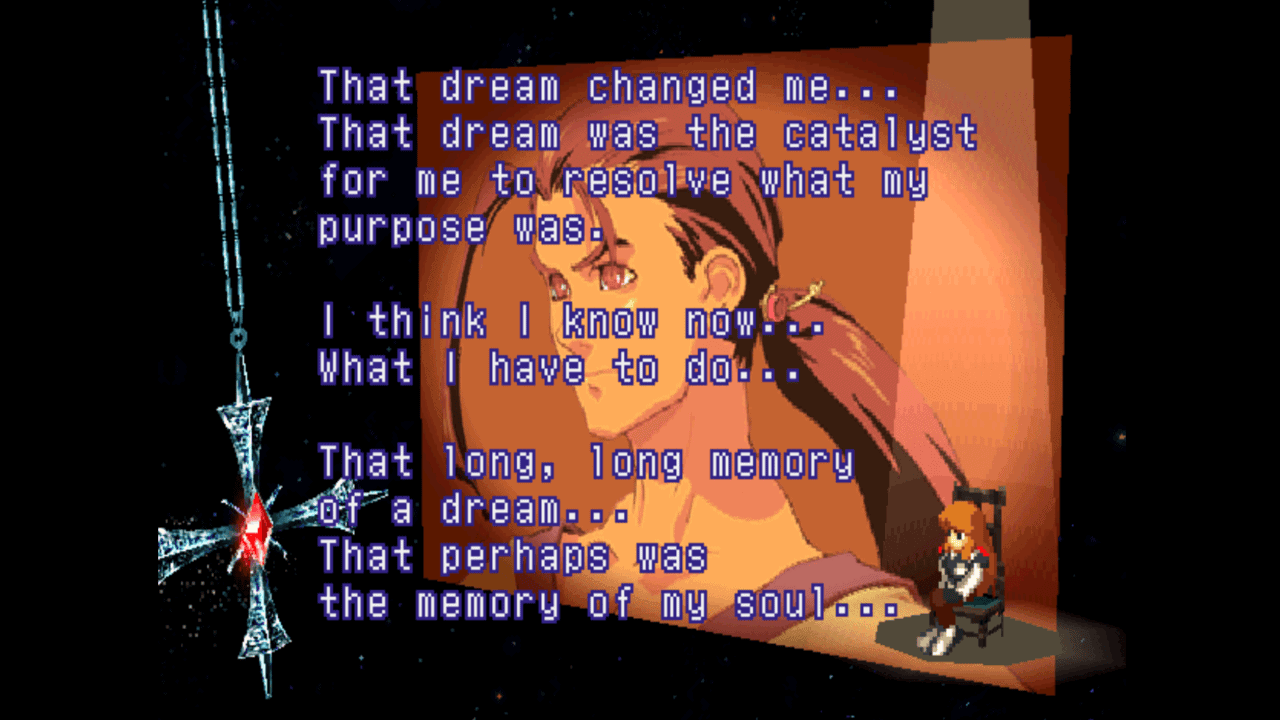
Perhaps, like a lot of this game, it was all meant to lead to something greater, and due to the development issues, it didn’t. If you don’t know, the second disc of Xenogears is very clearly a compromised state. To get this story to the finish line, several areas had to have been cut, with most of the remaining story being told through characters sitting in a chair, describing events with PNGs and screenshots in the background. It gets so bad that the characters start describing the visuals of cut dungeons and even the enemies encountered in them. It’s rough.
This is also where most of the game’s most interesting ideas are found. Some of the most interesting concepts for villains and a whole slew of esoteric references mixed in with Jungian symbols. As someone who wrote a thesis on Gnosticism, these really did not surprise me per se, but I did find them very compelling. Maybe I’d even like them if they weren’t wrapped up in annoying gimmick fights that require you to sit through minutes of cutscenes each time you want to retry one.
To think that the absolute slog of teases, slow reveals, and underexplored themes all led to this was just so disappointing. Still, I think as far as the use of these topics for creating worlds goes, the second disk certainly delivers an interesting mixture. Demiurges, Divine Sparks, as well as Anima and Animus are fascinating ideas that can be tackled from so many angles, and Xenogears goes far beyond just tackling them, instead creating a world that was clearly meant to go deeper than just this one game, even though this potential was never fully realized.
To get here, however, you don’t only need to trudge through a middling story in the first disc, but also grindy, middling dungeons and mechanics. Deathblows are these awesome, powerful attack animations unlocked by pressing the right button combinations on regular attacks, and are unlocked by pressing these buttons (unless they aren’t, the requirements can get quite bizarre and arbitrary for the later ones) during combat. You’re basically pressing buttons in hopes your made-up combos eventually turn into an actual move. You can check their progress in a menu (which buffers before opening up, because everything in this game has to be slow), but there’s no way to tell which specific moves affected their growth. And you want to unlock at least some of the stronger ones, as your strongest deathblow is going to be your attack of choice in most situations. Although it’s not like any of this matters too much—none of the final battles are fought on foot.
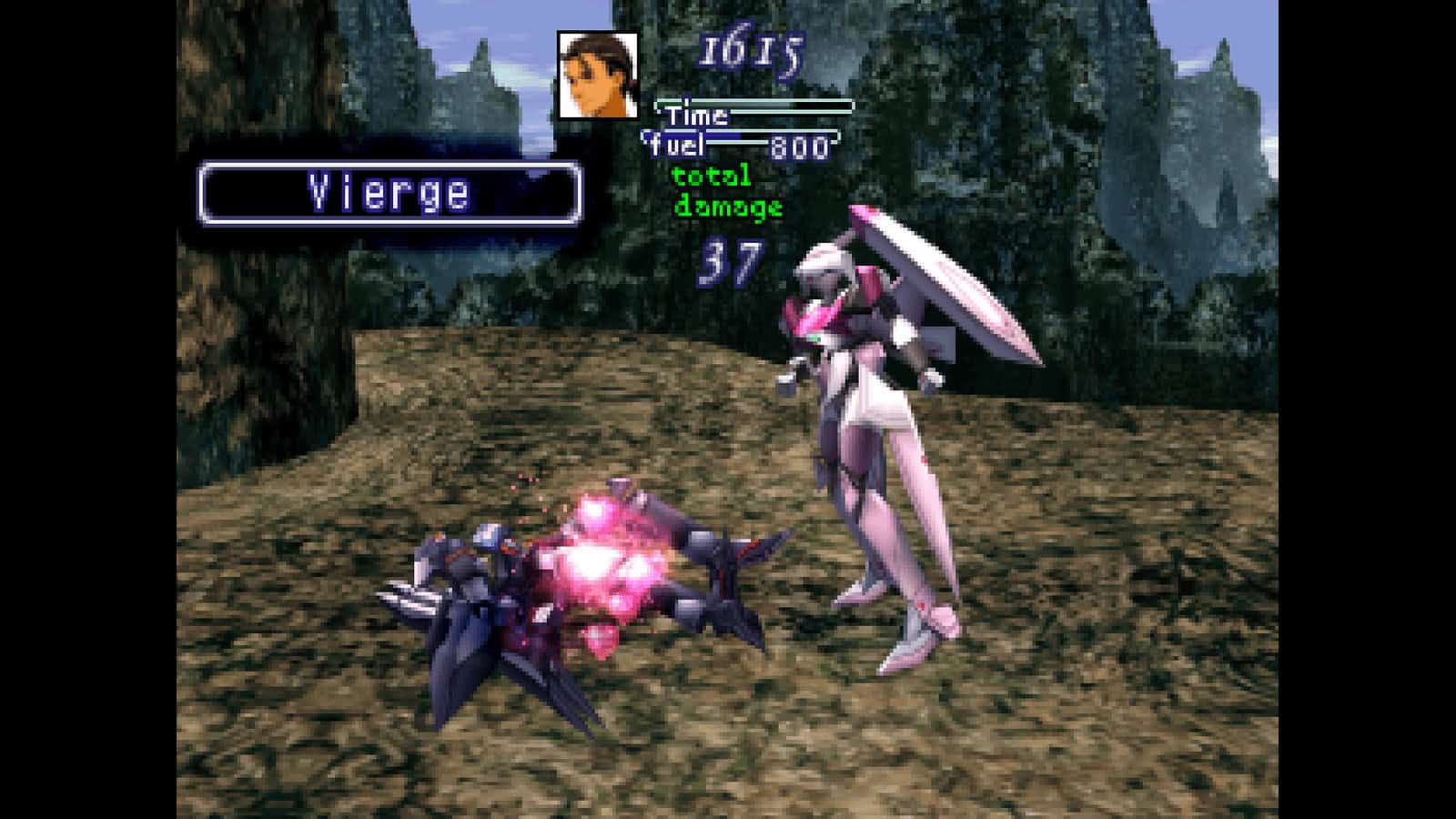
That’s because they are fought from inside the mechs, here called Gears. Their unique combat system ultimately amounts to this: when fighting regular enemies, hit the strong attack until they’re dead. When fighting bosses, press the booster, and do this until your power meter is high enough that you can execute your best combo. It certainly was a choice to make most of the final fights use the less flexible, more monotonous combat system. Even spells, which normally offer at least a bit of variety, even if they’re rarely necessary, are less effective in Gears in comparison to these attacks.
These gears do eat up fuel on each action, and there’s a bit of strategy there. If you run out of fuel, you’re out of luck. This never really happened to me, however, and I could always use my most powerful options on every boss. Long dungeons even tend to have a refill robot before the final encounter, rendering the resource management arbitrary, leaving the bigger dungeons as just boring, long corridors. And there’s a lot of them. An occasional puzzle helps to slightly reduce the unexciting encounters. Getting lost is common, and will mean you’ll be overleveled for most of the rest of the game.
There’s one dungeon in particular that consists of three different random encounters, meaning each time you fail to grasp one of them and get wrecked, you go back to the beginning. After you do understand them, they are just time-wasters. It’s too late into disc 1 to be worth grinding out, especially since the story beat that takes you there calls for swift action, so you’re stuck walking a few steps and having to repeat the steps to solve these puzzles.
To me, these are all signs of a yet-unexperienced crew that maybe did not have enough time to refine everything as much as they’d want to. But there’s no reason to make assumptions; the truth is that the version of Xenogears we have right now is full of potential that gets genuinely wasted on bad pacing, lack of involvement from the cast, and a tragic conclusion to the team’s efforts. If, unlike me, you have yet to truly tango with the themes of this game, there’s still a lot to find here that could have a profound impact that was wasted on me personally.
While playing the game, the biggest point of comparison was not any other game, but rather my time watching mecha anime from the 1980s to the mid-1990s. From the original Mobile Suit Gundam to the genre’s most popular export that is Neon Genesis Evangelion, the most important works of mecha were often plagued with production problems. Mobile Suit Gundam was not a commercial hit on release, having to cut its final arc, where a lot of the series’ most important concepts are introduced, down by nine episodes.
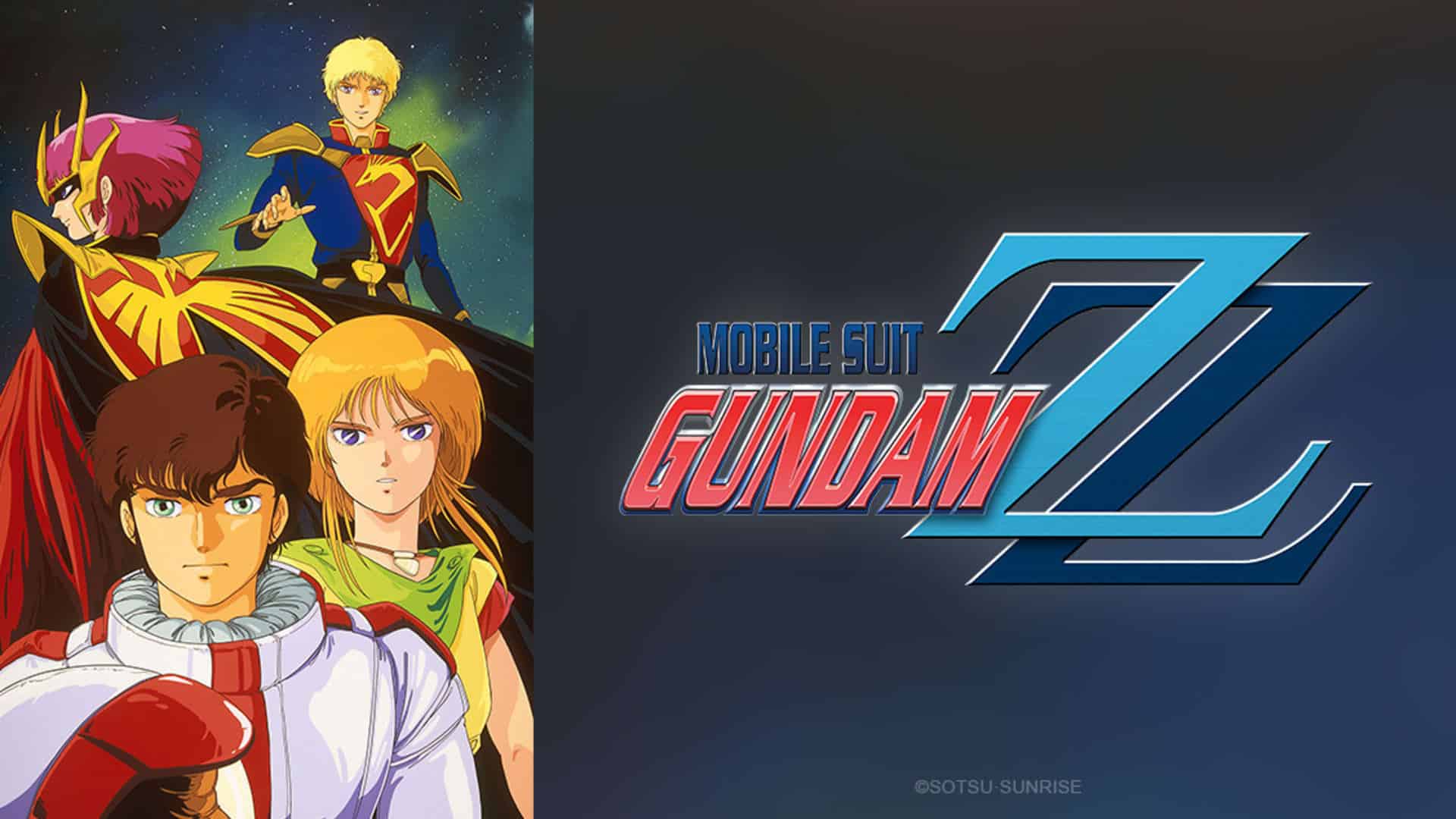
The one show that kept popping up in my mind as I played Xenogears was Mobile Suit Gundam ZZ. The third TV show of the original Universal Century storyline of the Gundam series, it’s a show filled with wild tonal shifts and logical leaps that I’ve never gelled with, but one that has its fans. Just like its predecessors, it is in many ways a product of its time. Tons of slapping, and a deep-rooted belief in gender roles. The trilogy does, however, put the hope for the future in the hands of humanity’s next generation. Far from a 1-1 parallel, the manic nature of Gundam ZZ has a weirdly alluring aura to it that I’d definitely recommend if you enjoyed the tone of Xenogears.
Ironically, Evangelion employs a very similar approach to Xenogears for its rushed finale of the protagonist explaining the finale in an abstract space—most famously, just like Xenogears, while sitting on a chair. There, however, the show engaged in eccentricities of a visual medium. Xenogears cuts reactivity and does not even offer moving images in return. Here I’ll echo what everyone who played this game has been saying for decades: Xenogears deserves a remake like nothing else. Not a port, not a remaster, but a remake that could turn the slideshows into playable segments and fix its worst parts. No amount of spiritual successors will satisfy anyone who played it to the end.
Of course it’s very difficult to imagine one, given the fact that Takahashi now works with Nintendo, but I truly believe it’s just a matter of time. How many stories like this have seen breakthroughs in recent years? Don’t forget, we are getting a sequel to Okami soon under Hideki Kamiya’s leadership. An enhanced port of Terranigma, a game few thought would ever come back, was announced as I’m writing this. Anything’s possible. Are you even a Xenogears fan if you don’t believe in a miracle this tiny?
 ObserverCrew Picks
 bserver
 bserver